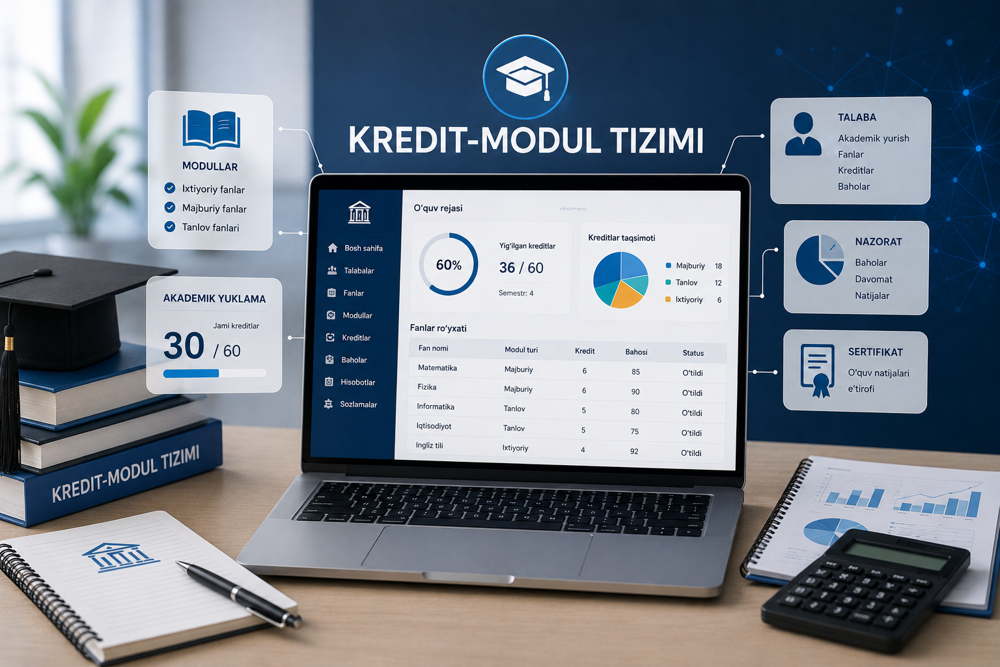
The Credit-Module System is one of the most widely adopted models of higher education worldwide. It is designed to improve the quality of education, encourage independent learning, and create a transparent and objective system for assessing students' academic performance. In Uzbekistan, this system has been gradually introduced as part of the ongoing modernization of higher education and its alignment with international educational standards.
Under the credit-module system, students earn academic credits by successfully completing courses and meeting learning outcomes. The system gives students greater flexibility in planning their studies, encourages continuous learning, and supports academic mobility between universities both nationally and internationally.
The Credit-Module System is an educational framework in which students' academic workload is measured using credits, while courses are organized into modules with clearly defined learning outcomes.
The system is based on several key components:
This structure allows universities to organize education more efficiently while ensuring transparency and consistency in student assessment.
An academic credit is a unit used to measure the total amount of work required to successfully complete a course.
A credit usually includes:
Students receive the assigned number of credits after successfully meeting all course requirements.
A module is a structured section of an academic program that focuses on a specific group of learning objectives and competencies.
Each module includes:
The modular approach makes education more organized, flexible, and student-centered.
The Credit-Module System offers numerous benefits for students and universities.
Its main advantages include:
These advantages contribute to improving the overall quality of higher education.
Independent learning is one of the fundamental principles of the Credit-Module System.
Students are expected to:
This approach develops critical thinking, research skills, and lifelong learning habits.
Student performance is evaluated continuously throughout the semester rather than relying solely on final examinations.
Assessment may include:
Continuous assessment provides a more comprehensive evaluation of students' knowledge and skills.
One of the greatest strengths of the Credit-Module System is academic mobility.
Students have opportunities to:
Academic mobility promotes international cooperation and broadens students' educational experiences.
The Credit-Module System places greater responsibility on students for managing their own learning.
Students are expected to:
Success depends largely on students' self-discipline and commitment.
In this educational model, instructors serve not only as teachers but also as mentors and academic advisors.
Their responsibilities include:
This student-centered approach creates a more collaborative learning environment.
Students can improve their academic performance by:
Developing these habits helps students achieve long-term academic success.
The Credit-Module System plays a significant role in improving higher education by:
It has become an essential component of modern higher education systems worldwide.
Students often encounter difficulties because they:
Avoiding these mistakes helps students maintain strong academic performance throughout the semester.
The Credit-Module System is a modern educational model that promotes flexibility, transparency, and student-centered learning in higher education. It enables students to manage their academic workload more effectively, develop independent learning skills, and participate in international educational opportunities through academic mobility. By understanding how academic credits, modules, assessments, and independent study work together, students can plan their education more efficiently and achieve higher academic success. Active participation, responsible learning habits, and continuous self-improvement are the keys to making the most of the Credit-Module System and preparing for a successful professional future.
SEO Keywords: Credit-Module System, academic credits, modular education, higher education, credit system, academic mobility, HEMIS, student assessment, independent learning, university education, educational reform, Bukhara State Pedagogical Institute.