




What Is Python? Features, Benefits, and Applications of the World's Most Popular Programming Language
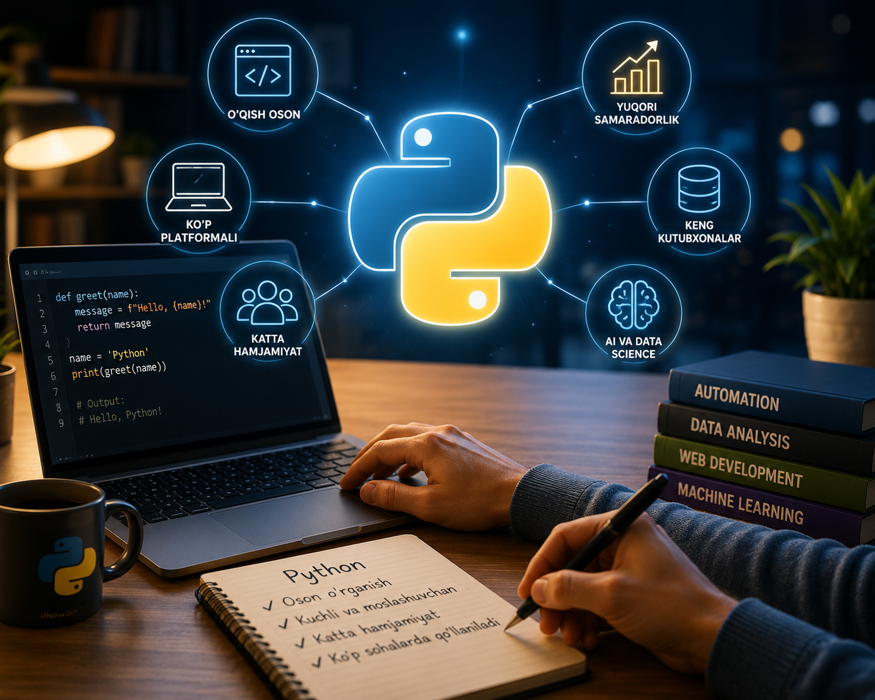
What Is Python? Features, Benefits, and Applications of the World's Most Popular Programming Language
What Is Python? Features, Benefits, and Applications of the World's Most Popular Programming Language
In today's digital era, programming has become one of the most valuable skills across nearly every industry. From education and healthcare to finance, scientific research, and artificial intelligence, software development plays a vital role in solving complex problems and creating innovative solutions. Among hundreds of programming languages, Python stands out as one of the most popular, versatile, and beginner-friendly languages in the world.
Python is known for its clean syntax, readability, and extensive ecosystem of libraries and frameworks. It enables developers to build websites, analyze data, automate repetitive tasks, create machine learning models, develop desktop applications, and much more. Because of its simplicity and flexibility, Python is widely recommended as the first programming language for beginners while remaining powerful enough for professional software engineers.
For students, educators, and researchers at the Bukhara State Pedagogical Institute, learning Python provides an excellent opportunity to develop digital competencies, participate in innovative research projects, and prepare for careers in today's technology-driven world.
1. What Is Python?
Python is a high-level, interpreted, general-purpose programming language that supports object-oriented, procedural, and functional programming paradigms.
Python was created by Guido van Rossum and officially released in 1991. Its primary goal was to provide a programming language that emphasizes readability, simplicity, and developer productivity.
Today, Python is:
-
open source;
-
free to use;
-
cross-platform;
-
highly scalable;
-
supported by millions of developers worldwide.
Its combination of simplicity and power has made Python one of the most widely used programming languages across the globe.
2. Key Features of Python
Python offers numerous features that contribute to its popularity.
Its major advantages include:
-
simple and readable syntax;
-
rapid development;
-
cross-platform compatibility;
-
automatic memory management;
-
extensive standard library;
-
thousands of third-party packages;
-
strong community support;
-
excellent documentation.
These features make Python suitable for both beginners and experienced software developers.
3. Where Is Python Used?
Python is an extremely versatile programming language with applications across many industries.
Common application areas include:
-
web development;
-
artificial intelligence;
-
machine learning;
-
data science;
-
data analytics;
-
scientific computing;
-
automation and scripting;
-
cybersecurity;
-
robotics;
-
cloud computing;
-
Internet of Things (IoT);
-
desktop application development;
-
game development.
Its flexibility allows developers to build almost any type of software solution.
4. Python for Web Development
Python has become one of the leading technologies for building modern web applications.
Popular Python web frameworks include:
-
Django;
-
Flask;
-
FastAPI.
Using these frameworks, developers create:
-
Customer Relationship Management (CRM) systems;
-
Learning Management Systems (LMS);
-
e-commerce platforms;
-
enterprise software;
-
government information systems;
-
RESTful APIs;
-
content management systems.
Many high-performance and scalable web applications rely on Python technologies.
5. Python and Artificial Intelligence
Python is considered the leading programming language for Artificial Intelligence and Machine Learning.
Popular AI libraries include:
-
TensorFlow;
-
PyTorch;
-
Scikit-learn;
-
Hugging Face Transformers;
-
Keras;
-
OpenCV.
Python enables developers to build:
-
intelligent chatbots;
-
recommendation systems;
-
computer vision applications;
-
speech recognition software;
-
natural language processing solutions;
-
generative AI applications.
Its rich ecosystem has made Python the preferred language for AI researchers and engineers worldwide.
6. Python in Education
Educational institutions around the world increasingly teach programming using Python.
This is because Python:
-
is easy to learn;
-
has a clean syntax;
-
allows students to focus on problem-solving rather than complex language rules;
-
supports modern educational technologies.
For students at the Bukhara State Pedagogical Institute, Python serves as an excellent foundation for developing computational thinking, programming skills, and digital literacy.
7. How to Start Learning Python
Anyone can begin learning Python without advanced mathematical knowledge.
A beginner should first understand:
-
variables;
-
data types;
-
operators;
-
conditional statements;
-
loops;
-
functions;
-
object-oriented programming;
-
file handling;
-
modules and libraries.
Building small practical projects helps reinforce these concepts and develop programming confidence.
8. Python and Career Opportunities
Python skills are highly valued by employers worldwide.
Professionals with Python expertise can pursue careers such as:
-
Backend Developer;
-
Full Stack Developer;
-
Data Analyst;
-
Data Scientist;
-
Machine Learning Engineer;
-
AI Engineer;
-
DevOps Engineer;
-
QA Automation Engineer;
-
Cybersecurity Specialist;
-
Software Engineer.
The global demand for Python developers continues to grow as organizations embrace digital transformation.
9. Tips for Learning Python Successfully
Learning Python effectively requires consistency and practice.
Recommended strategies include:
-
writing code every day;
-
building personal projects;
-
solving programming challenges;
-
learning Git and GitHub;
-
reading open-source code;
-
studying algorithms and data structures;
-
participating in programming communities.
Hands-on experience is the most effective way to master Python programming.
10. The Future of Python
Python continues to evolve alongside emerging technologies.
Future growth areas include:
-
Artificial Intelligence;
-
Machine Learning;
-
Data Science;
-
cloud computing;
-
automation;
-
robotics;
-
quantum computing;
-
educational technology;
-
cybersecurity;
-
scientific research.
Given its widespread adoption and active community, Python is expected to remain one of the world's most influential programming languages for many years.
Conclusion
Python is a modern, powerful, and versatile programming language that has transformed the software development landscape. Its readability, flexibility, and extensive ecosystem make it suitable for beginners while providing advanced capabilities for professionals working in artificial intelligence, web development, automation, scientific research, and data science. For students and educators of the Bukhara State Pedagogical Institute, mastering Python opens doors to innovation, research, career advancement, and participation in the rapidly evolving global digital economy.
SEO Keywords: Python, Python programming language, what is Python, learn Python, Python tutorial, Django, Flask, FastAPI, Artificial Intelligence, Machine Learning, Data Science, backend development, automation, programming education, Bukhara State Pedagogical Institute.