(365) 226-10-97 buxdpi@buxdpi.uz 2 Piridastgir Street, Bukhara City
shape
shape

Google Classroom: A Modern Platform for Managing Teaching and Learning

Google Classroom: A Modern Platform for Managing Teaching and Learning

Google Classroom: A Modern Platform for Managing Teaching and Learning

The rapid advancement of digital technologies has transformed the way education is delivered around the world. Schools, colleges, and universities increasingly rely on online learning platforms to organize courses, distribute learning materials, communicate with students, and assess academic performance. Among the most widely used educational platforms is Google Classroom, a free cloud-based learning management system developed by Google.

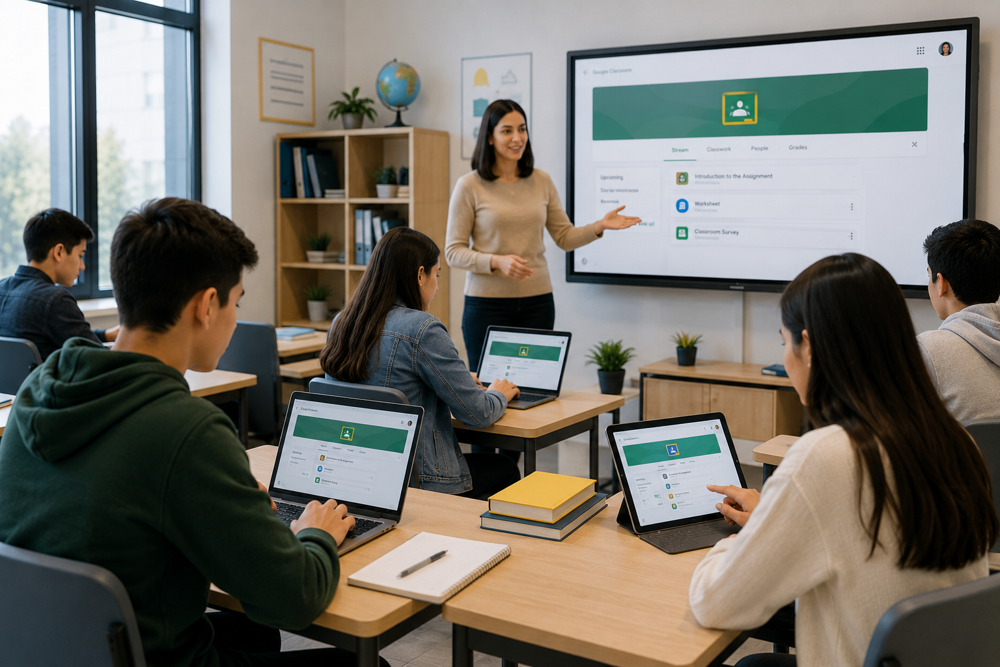
Google Classroom simplifies teaching and learning by bringing together assignments, communication, grading, and collaboration into one easy-to-use platform. Whether education takes place in a traditional classroom, online, or through blended learning, Google Classroom provides educators and students with the tools they need to stay organized and connected.

For students and future educators of the Bukhara State Pedagogical Institute, mastering Google Classroom is an important step toward developing digital teaching competencies and preparing for modern educational environments.


1. What Is Google Classroom?

Google Classroom is a cloud-based educational platform designed to help teachers create, manage, and organize online classes while allowing students to access learning materials, submit assignments, and communicate with instructors.

The platform enables users to:

  • create virtual classrooms;

  • enroll students using invitation codes;

  • distribute learning materials;

  • assign and collect homework;

  • grade assignments;

  • share announcements;

  • facilitate communication between teachers and students.

Since everything is stored in the cloud, users can access their courses from computers, tablets, or smartphones with an internet connection.


2. Key Features of Google Classroom

Google Classroom offers numerous features that simplify classroom management.

Some of its most useful features include:

  • assignment creation and submission;

  • automatic organization of coursework;

  • digital grading;

  • announcements and class discussions;

  • document sharing;

  • progress tracking;

  • mobile accessibility.

These tools help teachers save time while improving the overall learning experience.


3. Benefits for Teachers

Google Classroom supports educators by making classroom management more efficient.

Teachers can:

  • organize lessons by topics;

  • upload presentations, videos, and documents;

  • assign homework with deadlines;

  • provide personalized feedback;

  • monitor student participation;

  • evaluate academic performance digitally.

As a result, teachers spend less time on administrative tasks and more time supporting student learning.


4. Benefits for Students

Students also gain many advantages from using Google Classroom.

They can:

  • access learning materials anytime;

  • submit assignments online;

  • receive immediate feedback;

  • communicate with instructors;

  • collaborate with classmates;

  • monitor assignment deadlines and grades.

The platform encourages students to become more organized and responsible learners.


5. Integration with Google Workspace

One of Google Classroom's greatest strengths is its seamless integration with Google Workspace for Education.

It works directly with:

  • Google Drive;

  • Google Docs;

  • Google Sheets;

  • Google Slides;

  • Google Forms;

  • Google Meet;

  • Google Calendar;

  • Gmail.

This integration creates a unified digital learning environment where all educational resources are connected.


6. Supporting Online and Blended Learning

Google Classroom is suitable for multiple teaching models, including:

  • fully online learning;

  • blended learning;

  • flipped classrooms;

  • project-based learning;

  • independent study;

  • collaborative learning.

Its flexibility allows educational institutions to adapt to different teaching needs and learning styles.


7. Google Classroom and Artificial Intelligence

Artificial intelligence is increasingly being integrated into educational practices alongside Google Classroom.

AI tools can help educators:

  • prepare lesson plans;

  • generate quizzes;

  • create educational content;

  • personalize learning experiences;

  • analyze student progress;

  • automate repetitive administrative tasks.

However, teachers and students should always verify AI-generated content and maintain academic integrity when using these technologies.


8. Best Practices for Using Google Classroom

To maximize the platform's effectiveness, educators should:

  • organize content into clearly defined topics;

  • provide detailed assignment instructions;

  • set realistic submission deadlines;

  • give timely and constructive feedback;

  • use Google Forms for assessments;

  • schedule virtual meetings with Google Meet;

  • regularly update course materials.

These practices contribute to a more engaging and efficient learning experience.


9. Limitations of Google Classroom

Although Google Classroom offers many advantages, it also has certain limitations.

These include:

  • dependence on a stable internet connection;

  • fewer advanced features than some enterprise learning management systems (LMS);

  • the need for basic digital literacy;

  • limited offline functionality.

Despite these limitations, Google Classroom remains one of the most practical and accessible educational platforms available today.


10. Why Should Future Teachers Learn Google Classroom?

Digital competence has become an essential requirement for modern educators.

Learning Google Classroom enables future teachers to:

  • organize digital classrooms effectively;

  • manage assignments efficiently;

  • improve communication with students;

  • implement blended learning strategies;

  • integrate educational technologies into teaching;

  • prepare for the digital transformation of education.

These competencies significantly enhance teaching quality and professional readiness.


Conclusion

Google Classroom has become one of the world's leading digital learning platforms by making education more organized, accessible, and collaborative. Its integration with Google Workspace, user-friendly interface, and powerful classroom management tools support both teachers and students in achieving better learning outcomes. As education continues to embrace digital transformation, proficiency in Google Classroom has become an essential skill for educators. Students and future teachers of the Bukhara State Pedagogical Institute who master this platform will be better prepared to create engaging learning environments, manage digital classrooms efficiently, and contribute to the future of education.

SEO Keywords: Google Classroom, Google Classroom for Education, online learning platform, digital education, Google Workspace for Education, blended learning, virtual classroom, educational technology, Bukhara State Pedagogical Institute, digital pedagogy.