In today's rapidly changing world, creative thinking has become one of the most valuable competencies for academic, professional, and personal success. Technological innovation, artificial intelligence (AI), globalization, and the emergence of new professions require individuals to generate original ideas, solve complex problems, and adapt to changing environments. Consequently, creativity is no longer viewed as a talent possessed by only a few people—it is a skill that can be developed through education, practice, and experience.
Educational institutions play a vital role in fostering creative thinking. Modern teachers are expected not only to deliver knowledge but also to encourage curiosity, imagination, innovation, and independent thinking. For students and future educators of the Bukhara State Pedagogical Institute, developing creative thinking is essential for becoming innovative professionals capable of meeting the challenges of the future.
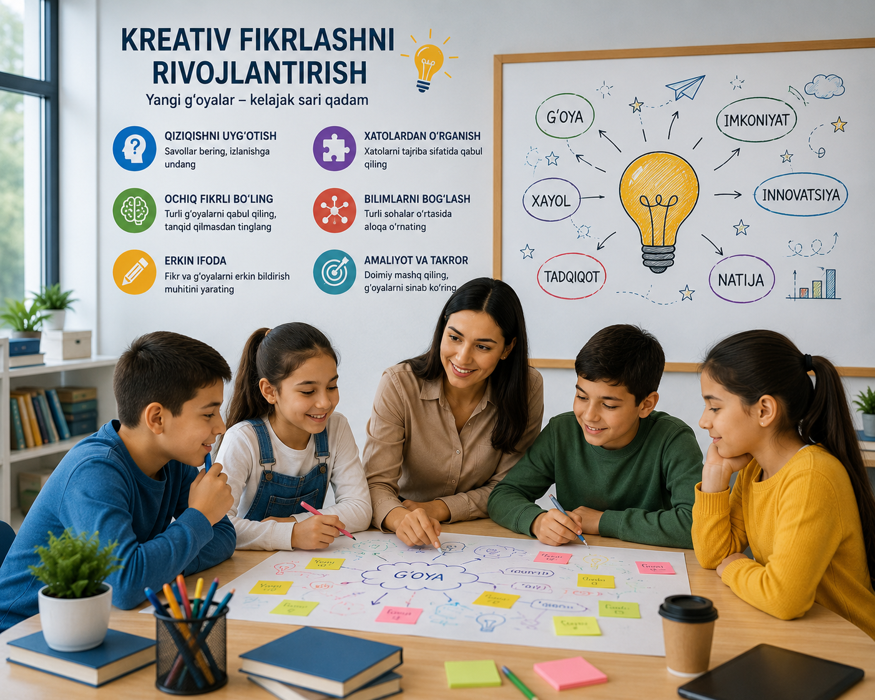
Creative thinking is the ability to generate original ideas, approach problems from different perspectives, and develop innovative solutions.
It involves:
imagination;
originality;
flexibility;
innovation;
problem-solving;
curiosity;
open-mindedness.
Creative thinking is a skill that can be strengthened through continuous learning and practical experience.
Creative thinking enables people to:
solve problems effectively;
develop innovative solutions;
adapt to changing environments;
improve decision-making;
achieve professional success;
contribute to social and economic development.
Organizations increasingly seek employees who can think creatively and generate new ideas.
Creativity plays a central role in modern education.
Teachers who encourage creativity help students:
become independent learners;
develop critical thinking;
improve communication skills;
increase motivation;
build confidence;
enjoy lifelong learning.
Creative classrooms encourage exploration instead of simple memorization.
Several educational approaches effectively promote creativity, including:
brainstorming;
project-based learning;
problem-based learning;
role-playing activities;
Design Thinking;
STEAM education.
These methods encourage active participation and innovative problem-solving.
Digital technologies provide new opportunities for creative learning.
Students and teachers can use:
graphic design software;
video editing tools;
artificial intelligence applications;
virtual laboratories;
interactive presentations;
digital storytelling platforms.
Technology enables learners to transform ideas into real-world projects more efficiently.
Artificial intelligence can support the creative process in many ways.
AI tools can help users:
generate ideas;
write texts and lesson plans;
create visual content;
organize projects;
explore different perspectives;
improve productivity.
However, AI should support—not replace—human imagination, originality, and critical thinking.
Several factors may limit creativity, such as:
fear of making mistakes;
rigid thinking patterns;
fear of criticism;
low motivation;
reluctance to experiment.
Teachers should create supportive learning environments where students feel safe expressing new ideas.
Students can strengthen creative thinking by:
reading diverse books;
learning new subjects;
participating in projects and competitions;
exploring multiple solutions to problems;
using AI tools responsibly;
keeping an idea journal.
Regular practice helps creativity become a natural habit.
Creative thinking is highly valuable across many industries, including:
education;
information technology;
design;
marketing;
entrepreneurship;
scientific research;
media and communications.
As automation increases, creativity becomes one of the most important human advantages in the workplace.
The importance of creativity will continue to grow as technology advances.
Future trends include:
collaboration between humans and AI;
innovation-driven education;
interdisciplinary learning;
creative entrepreneurship;
design-oriented problem-solving.
The professionals who combine creativity with technological competence will be best prepared for the future.
Creative thinking is one of the most essential skills for success in the 21st century. It empowers individuals to solve problems, generate innovative ideas, adapt to change, and contribute to educational, scientific, and economic development. Modern education should provide opportunities for learners to explore, experiment, and create rather than simply memorize information. Students and future educators of the Bukhara State Pedagogical Institute who actively develop creative thinking will be better prepared to implement innovative teaching methods, inspire future generations, and succeed in an increasingly dynamic and technology-driven world.
SEO Keywords: creative thinking, creativity development, innovative education, critical thinking, Design Thinking, STEAM education, artificial intelligence and creativity, future skills, Bukhara State Pedagogical Institute, 21st-century skills.