(365) 226-10-97 buxdpi@buxdpi.uz 2 Piridastgir Street, Bukhara City
shape
shape

What Is STEAM Education? An Innovative Approach to Modern Learning

What Is STEAM Education? An Innovative Approach to Modern Learning

What Is STEAM Education? An Innovative Approach to Modern Learning

Education in the 21st century focuses not only on teaching theoretical knowledge but also on developing practical skills, creativity, critical thinking, collaboration, and problem-solving abilities. One of the most effective educational approaches that supports these goals is STEAM education. By integrating multiple disciplines into a unified learning experience, STEAM prepares students for real-world challenges and future careers.

Today, STEAM education is widely adopted by educational institutions around the world because it promotes innovation, interdisciplinary learning, and hands-on experiences. For students and future teachers of the Bukhara State Pedagogical Institute, understanding STEAM methodology provides valuable opportunities to design engaging lessons, integrate modern technologies into education, and prepare learners for the demands of the digital age.


1. What Is STEAM Education?

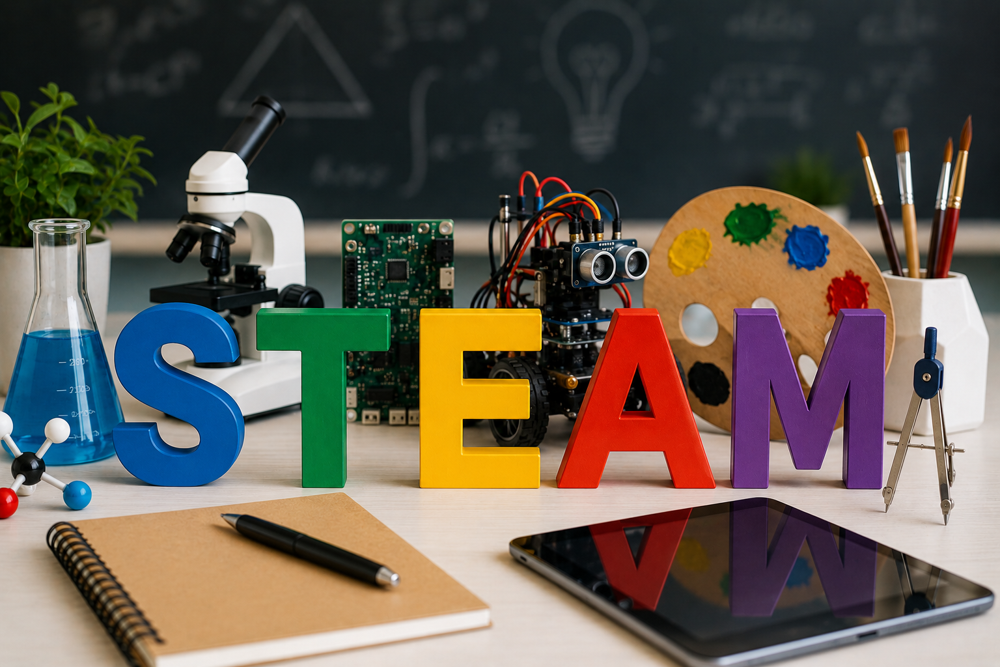
STEAM is an interdisciplinary educational approach that combines five major fields:

  • S – Science
  • T – Technology
  • E – Engineering
  • A – Arts
  • M – Mathematics

Rather than teaching these subjects separately, STEAM encourages students to connect concepts from different disciplines to solve real-life problems creatively and effectively.


2. The Purpose of STEAM Education

The primary goal of STEAM education is to equip learners with knowledge, practical skills, and competencies required for success in modern society.

STEAM helps students develop:

  • critical thinking;
  • creativity;
  • problem-solving abilities;
  • collaboration skills;
  • project-based learning experience;
  • research and analytical skills.

Students become active participants in the learning process instead of passive recipients of information.


3. Benefits of STEAM Education

STEAM offers numerous educational advantages, including:

  • interdisciplinary learning;
  • hands-on practical experiences;
  • improved creativity and innovation;
  • higher student engagement;
  • stronger analytical thinking;
  • better preparation for future careers.

By connecting classroom learning with real-world applications, students gain a deeper understanding of academic concepts.


4. How Are STEAM Lessons Conducted?

STEAM lessons emphasize exploration, experimentation, and collaboration rather than memorization.

Typical classroom activities include:

  • scientific experiments;
  • engineering design projects;
  • prototype development;
  • real-world problem solving;
  • collaborative teamwork;
  • project presentations.

In this approach, teachers guide and support students while encouraging independent learning.


5. The Role of the Teacher

Teachers play a central role in successful STEAM implementation.

A STEAM educator should:

  • design engaging learning experiences;
  • encourage inquiry and investigation;
  • facilitate teamwork;
  • integrate modern technologies;
  • promote creativity and innovation.

Instead of simply delivering information, teachers help students discover knowledge through experience.


6. STEAM and Digital Technologies

Technology is an essential component of STEAM education.

Common digital tools include:

  • educational robotics;
  • 3D modeling and printing;
  • computer programming;
  • artificial intelligence (AI);
  • virtual laboratories;
  • digital simulations.

These technologies make learning more interactive, engaging, and relevant to today's world.


7. Assessment in STEAM Education

Assessment in STEAM focuses not only on final results but also on the learning process.

Students are evaluated based on:

  • creativity;
  • problem-solving skills;
  • teamwork;
  • project quality;
  • presentation skills;
  • critical thinking.

This comprehensive assessment encourages continuous improvement and deeper learning.


8. STEAM and Future Careers

STEAM education prepares students for many rapidly growing professions, including:

  • software developer;
  • engineer;
  • robotics specialist;
  • data analyst;
  • artificial intelligence specialist;
  • architect;
  • industrial designer;
  • environmental engineer.

It also equips future teachers with innovative instructional strategies suitable for modern classrooms.


9. Recommendations for Students

Students interested in STEAM should:

  • study interdisciplinary teaching methods;
  • participate in project-based learning;
  • strengthen digital literacy;
  • develop creativity and innovation skills;
  • engage in scientific research;
  • stay informed about emerging educational technologies.

Continuous learning is essential for success in both education and future careers.


10. Why Is STEAM Education Important?

STEAM education helps students:

  • improve academic performance;
  • develop practical and transferable skills;
  • increase creativity and innovation;
  • strengthen collaboration abilities;
  • prepare for technology-driven careers;
  • become lifelong learners.

As technology continues to transform society, STEAM education plays an increasingly important role in preparing future generations.


Conclusion

STEAM education is an innovative teaching approach that integrates Science, Technology, Engineering, Arts, and Mathematics into meaningful learning experiences. It encourages creativity, collaboration, critical thinking, and practical problem-solving while preparing students for future academic and professional success. Students and future teachers of the Bukhara State Pedagogical Institute who understand and apply STEAM principles will be better equipped to create engaging learning environments, integrate modern technologies into education, and prepare learners for success in a rapidly evolving digital world.

SEO Keywords: STEAM education, STEAM learning, interdisciplinary education, STEM vs STEAM, educational innovation, project-based learning, digital education, future skills, Bukhara State Pedagogical Institute, educational technology.