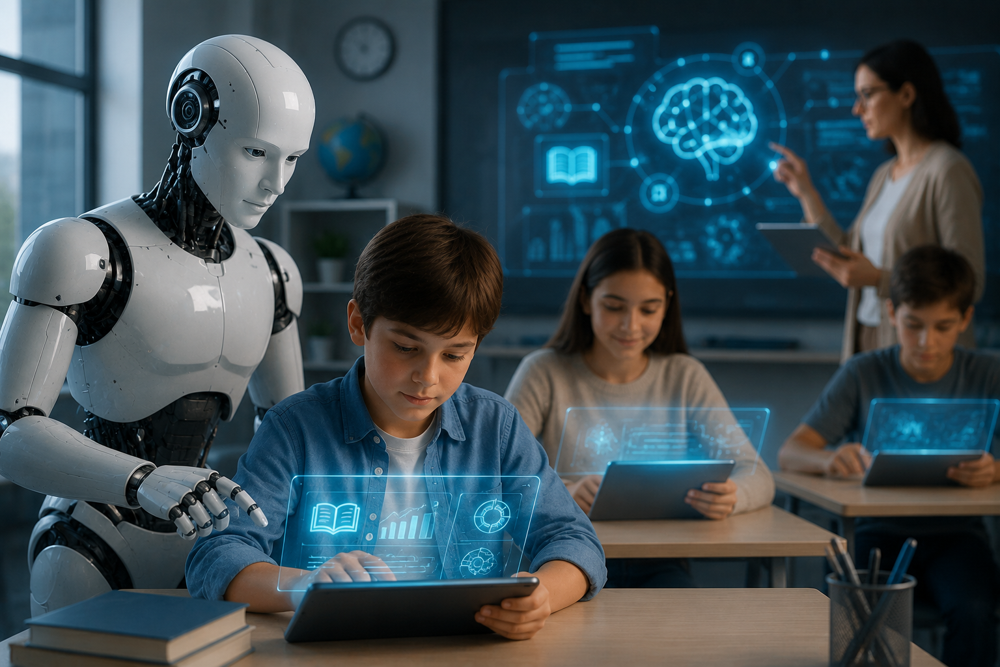
Artificial Intelligence (AI) is transforming nearly every aspect of modern life, and education is no exception. AI-powered technologies are reshaping how teachers teach, how students learn, and how educational institutions manage learning processes. From personalized learning experiences to intelligent tutoring systems and automated assessment, AI is creating new opportunities to improve educational quality and accessibility.
Rather than replacing teachers, artificial intelligence serves as a powerful educational assistant. It helps educators reduce routine tasks, analyze student performance, create learning materials, and provide more individualized instruction. For students and future teachers of the Bukhara State Pedagogical Institute, understanding AI technologies has become an essential part of professional development in the digital era.
Artificial Intelligence (AI) refers to computer systems that can perform tasks requiring human intelligence, including:
analyzing data;
generating text;
recognizing speech;
processing images;
making recommendations;
solving complex problems;
learning from data.
In education, AI supports both teaching and learning through intelligent digital technologies.
Artificial intelligence is increasingly applied across many educational activities.
Common applications include:
lesson planning;
generating quizzes and examinations;
creating educational content;
automated grading;
language translation;
intelligent chatbots;
learning analytics;
academic support systems.
These tools help educators save time while improving the learning experience.
One of AI's greatest strengths is its ability to personalize education.
AI can:
identify students' learning levels;
recommend suitable learning materials;
adapt lesson difficulty;
monitor learning progress;
provide individualized feedback.
Personalized learning enables every student to learn according to their own pace and needs.
Artificial intelligence supports teachers in many aspects of their work.
It can help educators:
prepare lesson plans;
design presentations;
generate classroom activities;
create assessments;
analyze student performance;
reduce administrative workload.
As a result, teachers can spend more time engaging directly with students.
AI technologies make learning more engaging and interactive.
Examples include:
intelligent tutoring systems;
AI-powered chatbots;
virtual learning assistants;
adaptive learning platforms;
interactive educational simulations.
These technologies encourage active participation and improve student motivation.
Responsible AI use requires maintaining academic integrity.
Students and educators should:
verify AI-generated information;
cite sources appropriately;
avoid plagiarism;
use AI as a learning assistant rather than a replacement for independent thinking;
critically evaluate AI responses.
Human judgment remains essential in education.
Despite its many advantages, AI also presents several challenges.
These include:
inaccurate or outdated information;
privacy and data protection concerns;
unequal access to technology;
digital literacy gaps;
ethical issues surrounding AI-generated content.
Educational institutions should develop clear guidelines for responsible AI use.
Modern educators should develop competencies in:
AI literacy;
prompt engineering;
digital pedagogy;
information security;
media literacy;
critical thinking;
ethical use of technology.
These skills are becoming increasingly valuable in contemporary education.
Students preparing for future careers should:
learn how AI tools work;
use AI responsibly;
strengthen analytical thinking;
improve foreign language proficiency;
enhance digital competencies;
stay informed about technological developments.
Understanding AI will become an important professional advantage across many fields.
Many experts believe artificial intelligence will continue to transform education over the coming decades.
Future developments may include:
fully personalized learning pathways;
intelligent assessment systems;
AI-supported curriculum design;
predictive learning analytics;
immersive educational experiences;
smarter educational decision-making.
However, teachers will remain at the heart of education by providing guidance, mentorship, emotional support, and ethical leadership—qualities that technology cannot replace.
Artificial intelligence is transforming education by making learning more personalized, efficient, and accessible. It supports teachers in planning lessons, creating educational resources, assessing student performance, and delivering individualized instruction. At the same time, responsible AI use requires digital literacy, ethical awareness, critical thinking, and academic integrity. Students and future teachers of the Bukhara State Pedagogical Institute who develop AI-related competencies will be well prepared to lead innovation in education and contribute to building a modern, technology-enhanced learning environment.
SEO Keywords: artificial intelligence in education, AI in education, ChatGPT for education, digital pedagogy, educational technology, AI for teachers, personalized learning, future of education, Bukhara State Pedagogical Institute, AI literacy.