(365) 226-10-97 buxdpi@buxdpi.uz 2 Piridastgir Street, Bukhara City
shape
shape

Cloud Computing: The Foundation of Modern Digital Infrastructure

Cloud Computing: The Foundation of Modern Digital Infrastructure

Cloud Computing: The Foundation of Modern Digital Infrastructure

Cloud Computing: The Foundation of Modern Digital Infrastructure

Cloud Computing has become one of the most transformative technologies of the 21st century. Organizations of all sizes—from startups and educational institutions to multinational corporations and government agencies—are increasingly adopting cloud services to store data, run applications, and manage IT infrastructure. By providing computing resources over the Internet, cloud computing enables businesses to become more agile, scalable, and cost-effective.

Instead of investing heavily in physical servers and maintaining complex data centers, organizations can access virtual machines, storage, databases, networking, and software services on demand. This shift has revolutionized how applications are developed, deployed, and managed, making cloud computing an essential technology for the digital economy.

For students and educators at the Bukhara State Pedagogical Institute, learning cloud computing provides valuable knowledge for careers in software engineering, system administration, DevOps, cybersecurity, artificial intelligence, data science, and enterprise IT management.


1. What Is Cloud Computing?

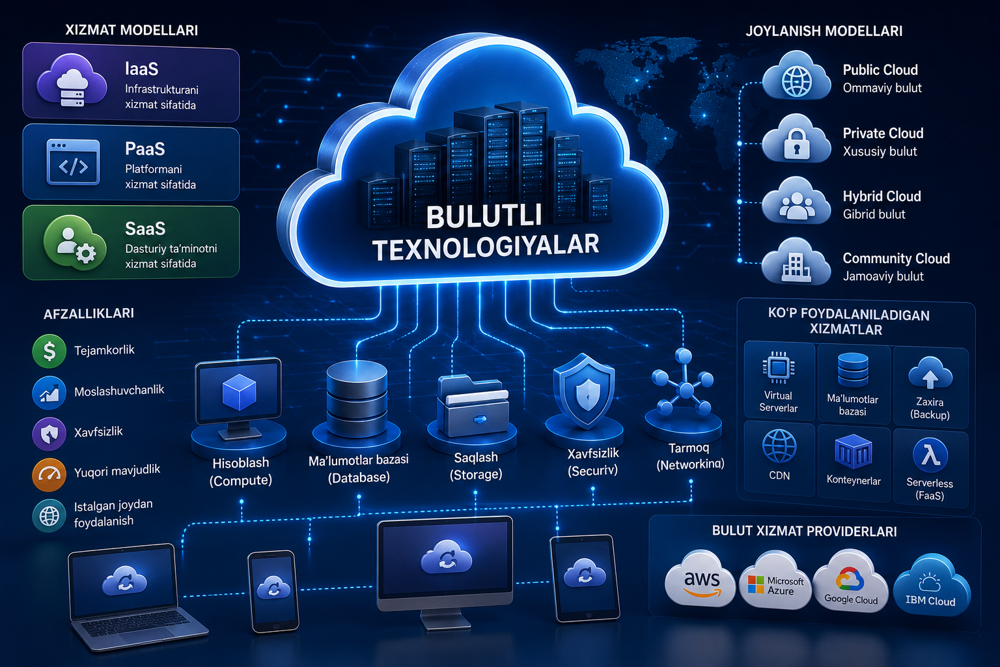
Cloud Computing is the delivery of computing services—including servers, storage, databases, networking, software, analytics, and artificial intelligence—over the Internet.

Instead of purchasing and maintaining physical hardware, users access cloud resources whenever they are needed.

Cloud services typically provide:

  • virtual servers;

  • online storage;

  • managed databases;

  • networking services;

  • application hosting;

  • backup solutions;

  • machine learning platforms;

  • monitoring and security tools.

Cloud computing allows organizations to focus on innovation instead of infrastructure maintenance.


2. Why Is Cloud Computing Important?

Traditional IT infrastructure requires significant investment in hardware, software licenses, maintenance, and technical staff.

Cloud computing offers several advantages:

  • lower operational costs;

  • rapid deployment;

  • high availability;

  • automatic scalability;

  • improved business continuity;

  • remote accessibility;

  • automatic updates;

  • better resource utilization.

These benefits have made cloud computing the preferred infrastructure model for modern organizations.


3. Cloud Service Models

Cloud services are generally categorized into three primary models.

Infrastructure as a Service (IaaS)

IaaS provides virtualized computing resources such as servers, networking, and storage.

Examples include:

  • Amazon EC2;

  • Microsoft Azure Virtual Machines;

  • Google Compute Engine.

IaaS gives organizations complete control over their operating systems and applications.


Platform as a Service (PaaS)

PaaS provides developers with a complete platform for building, testing, and deploying applications.

Examples include:

  • Google App Engine;

  • Heroku;

  • Azure App Service.

PaaS eliminates the need to manage the underlying infrastructure.


Software as a Service (SaaS)

SaaS delivers fully functional software applications over the Internet.

Examples include:

  • Gmail;

  • Google Docs;

  • Microsoft 365;

  • Zoom;

  • Dropbox.

Users simply access the software through a web browser without installing or maintaining it locally.


4. Cloud Deployment Models

Cloud infrastructure can be deployed using different approaches.

Public Cloud

Resources are shared among multiple customers and managed by a cloud provider.

Private Cloud

Cloud infrastructure is dedicated to a single organization, providing greater control and security.

Hybrid Cloud

A combination of public and private cloud environments that allows organizations to balance flexibility and security.

Multi-Cloud

Organizations use services from multiple cloud providers to improve resilience, optimize costs, and avoid vendor lock-in.

Selecting the right deployment model depends on business requirements and regulatory needs.


5. Benefits of Cloud Computing

Cloud computing provides numerous advantages for organizations and individuals.

Major benefits include:

  • scalability;

  • flexibility;

  • cost efficiency;

  • high reliability;

  • disaster recovery;

  • automatic backup;

  • global accessibility;

  • enhanced security;

  • faster application deployment;

  • improved collaboration.

These benefits enable businesses to innovate more rapidly and respond quickly to changing market demands.


6. Leading Cloud Providers

Several companies dominate the global cloud computing market.

The most popular cloud platforms include:

  • Amazon Web Services (AWS);

  • Microsoft Azure;

  • Google Cloud Platform (GCP);

  • Oracle Cloud Infrastructure (OCI);

  • IBM Cloud;

  • Alibaba Cloud;

  • DigitalOcean;

  • Cloudflare.

Each provider offers a wide range of services tailored to different industries and workloads.


7. Applications of Cloud Computing

Cloud computing is used across nearly every industry.

Common application areas include:

  • education;

  • healthcare;

  • banking and finance;

  • e-commerce;

  • government services;

  • media and entertainment;

  • artificial intelligence;

  • big data analytics;

  • Internet of Things (IoT);

  • scientific research.

Cloud technologies continue to accelerate digital transformation worldwide.


8. Cloud Computing and DevOps

Cloud computing has become the foundation of modern DevOps practices.

Frequently used cloud-native technologies include:

  • Docker;

  • Kubernetes;

  • Continuous Integration and Continuous Deployment (CI/CD);

  • Infrastructure as Code (IaC);

  • GitHub Actions;

  • Terraform;

  • Ansible.

These technologies enable organizations to automate software development, testing, deployment, and infrastructure management.


9. How to Learn Cloud Computing

A structured learning path can help beginners build strong cloud computing skills.

Recommended steps include:

  1. Learn computer networking fundamentals.

  2. Master Linux basics.

  3. Learn Git and GitHub.

  4. Understand Docker containers.

  5. Study one major cloud platform such as AWS, Azure, or Google Cloud.

  6. Learn Kubernetes and container orchestration.

  7. Build real-world cloud projects.

  8. Prepare for internationally recognized cloud certifications.

Hands-on practice using cloud platforms is essential for gaining practical experience.


10. The Future of Cloud Computing

Cloud computing continues to evolve rapidly with emerging technologies.

Future trends include:

  • Serverless Computing;

  • Edge Computing;

  • AI-powered cloud services;

  • Cloud Security;

  • Green Computing;

  • Quantum Computing integration;

  • Multi-Cloud architectures;

  • Cloud-Native applications.

As organizations continue their digital transformation, demand for cloud professionals will continue to grow worldwide.


Conclusion

Cloud computing has fundamentally transformed the way organizations build, deploy, and manage digital services. By offering scalable, reliable, and cost-effective computing resources through the Internet, cloud platforms enable innovation across every industry. Professionals with cloud computing expertise are in high demand, particularly in software development, DevOps, cybersecurity, artificial intelligence, and enterprise IT. For students and educators at the Bukhara State Pedagogical Institute, mastering cloud computing provides a strong foundation for future careers, international certifications, and participation in the rapidly expanding global technology ecosystem.

SEO Keywords: Cloud Computing, cloud technology, cloud services, AWS, Microsoft Azure, Google Cloud Platform, IaaS, PaaS, SaaS, DevOps, Docker, Kubernetes, Cloud Security, Serverless Computing, Multi-Cloud, Bukhara State Pedagogical Institute.