State symbols





What Are HTML and CSS? The Fundamental Technologies Behind Modern Websites
What Are HTML and CSS? The Fundamental Technologies Behind Modern Websites
What Are HTML and CSS? The Fundamental Technologies Behind Modern Websites
The Internet has become an essential part of modern life, connecting billions of people through websites, web applications, online services, and digital platforms. Every website, from a simple personal blog to a large e-commerce platform or government portal, is built using core web technologies. Among these technologies, HTML and CSS serve as the foundation of virtually every web page on the Internet.
Anyone interested in web development begins their journey by learning HTML and CSS. These technologies provide the essential skills needed to build attractive, responsive, and user-friendly websites. They are valuable not only for software developers but also for web designers, content managers, SEO specialists, digital marketers, and anyone involved in creating or managing online content.
For students, educators, and technology enthusiasts at the Bukhara State Pedagogical Institute, learning HTML and CSS is an important step toward developing digital literacy, building modern web applications, and preparing for careers in the rapidly growing field of information technology.
1. What Is HTML?
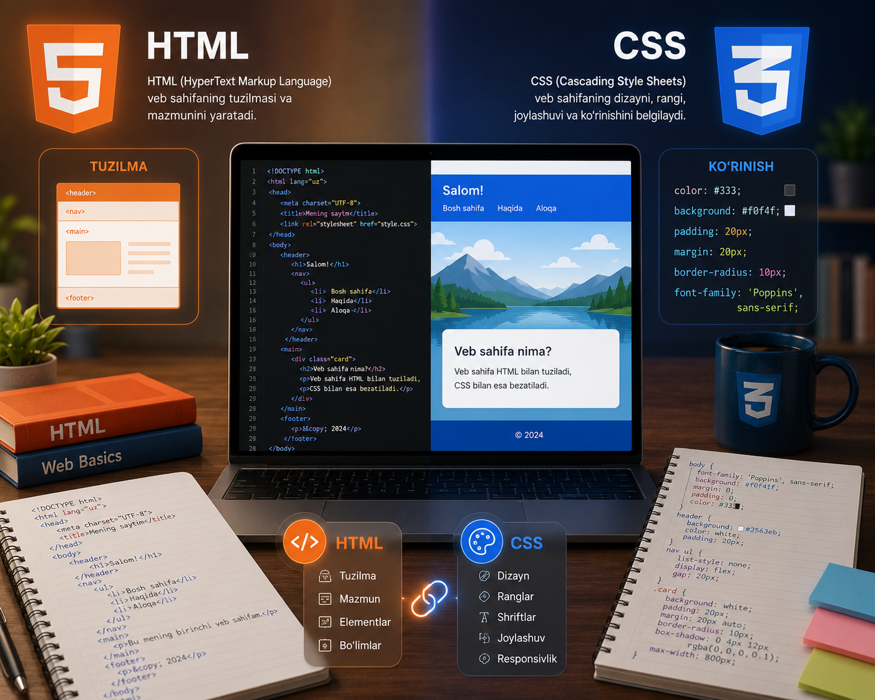
HTML (HyperText Markup Language) is the standard markup language used to create the structure and content of web pages.
HTML defines the elements that appear on a webpage, including:
-
headings;
-
paragraphs;
-
images;
-
videos;
-
hyperlinks;
-
tables;
-
forms;
-
buttons;
-
lists;
-
page sections.
Web browsers read HTML code and render it into the visual pages users see every day.
It is important to note that HTML is not a programming language. Instead, it is a markup language that describes the structure and organization of web content.
2. What Is CSS?
CSS (Cascading Style Sheets) is the language used to control the appearance and layout of HTML documents.
CSS manages aspects such as:
-
colors;
-
fonts;
-
spacing;
-
page layouts;
-
backgrounds;
-
borders;
-
animations;
-
responsive design.
If HTML provides the structure of a website, CSS determines how that structure looks and behaves visually.
3. How Do HTML and CSS Work Together?
HTML and CSS complement one another.
The process works as follows:
-
HTML creates the webpage structure.
-
CSS styles and formats the content.
-
JavaScript adds interactivity and dynamic behavior.
A common analogy is:
-
HTML is the framework of a house.
-
CSS is the interior and exterior design.
-
JavaScript is the electrical and smart automation system.
Together, these three technologies form the foundation of modern web development.
4. Essential HTML Elements
HTML consists of various tags that define webpage components.
Common HTML elements include:
-
<html>; -
<head>; -
<body>; -
<header>; -
<nav>; -
<section>; -
<article>; -
<footer>; -
<h1>to<h6>; -
<p>; -
<a>; -
<img>; -
<table>; -
<form>; -
<button>.
Each element serves a specific purpose in organizing webpage content.
5. Major Features of CSS
CSS provides powerful tools for designing modern websites.
Its capabilities include:
-
custom colors;
-
typography;
-
responsive layouts;
-
Flexbox;
-
CSS Grid;
-
animations and transitions;
-
hover effects;
-
media queries;
-
visual effects and positioning.
Modern CSS enables developers to create professional and visually appealing interfaces without relying heavily on graphics.
6. Where Are HTML and CSS Used?
HTML and CSS are used in virtually every web-based project.
Common applications include:
-
business websites;
-
e-commerce stores;
-
educational platforms;
-
government portals;
-
Customer Relationship Management (CRM) systems;
-
Learning Management Systems (LMS);
-
blogs;
-
portfolio websites;
-
news websites;
-
web applications.
Regardless of complexity, every website depends on HTML and CSS.
7. Benefits of Learning HTML and CSS
Learning HTML and CSS offers numerous advantages.
Some of the most important benefits include:
-
an easy introduction to web development;
-
the ability to build personal websites;
-
preparation for frontend development;
-
better understanding of web design;
-
freelance career opportunities;
-
improved SEO knowledge;
-
a strong foundation for learning JavaScript and modern frameworks.
These technologies are among the most valuable skills for anyone entering the digital industry.
8. Tools for HTML and CSS Development
Developers use various tools to write and test HTML and CSS code.
Popular code editors include:
-
Visual Studio Code;
-
WebStorm;
-
Sublime Text;
-
Notepad++;
-
Brackets.
Common web browsers for testing include:
-
Google Chrome;
-
Mozilla Firefox;
-
Microsoft Edge;
-
Safari.
Browser Developer Tools allow developers to inspect webpage elements, debug layouts, and optimize performance efficiently.
9. How to Learn HTML and CSS Effectively
Success in learning HTML and CSS comes through consistent practice.
Recommended learning strategies include:
-
studying HTML fundamentals first;
-
mastering CSS selectors and properties;
-
building small personal projects;
-
practicing responsive web design;
-
learning Flexbox and CSS Grid;
-
exploring Bootstrap and Tailwind CSS;
-
using Git and GitHub for version control.
Practical experience is the fastest way to develop professional web development skills.
10. The Future of HTML and CSS
Although web technologies continue to evolve rapidly, HTML and CSS remain essential.
Future trends include:
-
advanced responsive web design;
-
improved CSS Grid capabilities;
-
Web Components;
-
Progressive Web Applications (PWAs);
-
AI-assisted interface design;
-
integration with modern JavaScript frameworks;
-
enhanced accessibility standards.
As new technologies emerge, HTML and CSS will continue to serve as the universal foundation of web development.
Conclusion
HTML and CSS are the cornerstone technologies of the modern web. HTML provides the structure and semantic organization of web pages, while CSS transforms that structure into visually engaging, responsive, and user-friendly interfaces. Together, they form the essential foundation for frontend development and every modern website. For students and educators of the Bukhara State Pedagogical Institute, mastering HTML and CSS opens opportunities to develop digital skills, create professional web projects, and build successful careers in today's global technology industry.
SEO Keywords: HTML, CSS, HTML tutorial, CSS tutorial, HTML5, CSS3, frontend development, web development, responsive web design, Flexbox, CSS Grid, Bootstrap, website development, learn HTML and CSS, Bukhara State Pedagogical Institute.