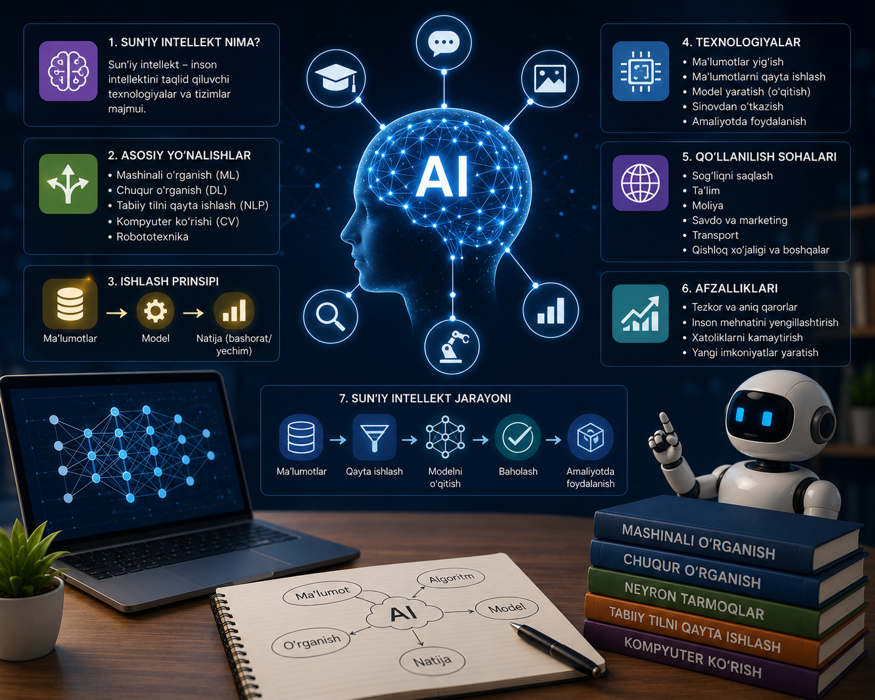
Artificial Intelligence (AI) has become one of the most transformative technologies of the 21st century. From healthcare and education to finance, transportation, manufacturing, and scientific research, AI is changing the way people live, work, and solve complex problems. By enabling computers to perform tasks that traditionally require human intelligence, AI is driving innovation, improving productivity, and creating entirely new opportunities across industries.
Today, understanding the fundamentals of Artificial Intelligence is no longer limited to computer scientists and software engineers. Educators, researchers, business professionals, healthcare workers, and students increasingly benefit from AI literacy as digital technologies become an essential part of everyday life. Learning AI provides valuable skills for adapting to the future workforce and participating in the rapidly evolving digital economy.
For students and educators at the Bukhara State Pedagogical Institute, studying Artificial Intelligence fundamentals supports digital competence, encourages innovative teaching methods, and prepares future professionals for careers in an AI-driven world.
Artificial Intelligence (AI) is a branch of computer science focused on developing systems capable of performing tasks that normally require human intelligence.
These tasks include:
learning from data;
recognizing patterns;
understanding language;
making decisions;
solving problems;
recognizing speech;
identifying images;
generating content.
Modern AI systems do not think or possess consciousness like humans. Instead, they process information using mathematical models, algorithms, and large datasets to accomplish specific tasks efficiently.
The concept of intelligent machines has evolved over several decades.
Major milestones include:
In 1950, Alan Turing introduced ideas about machine intelligence through the famous Turing Test.
In 1956, the term Artificial Intelligence was officially introduced during the Dartmouth Conference.
During the 1980s, expert systems became widely adopted.
The growth of the Internet and Big Data in the 2000s accelerated AI research.
Recent years have witnessed the rapid development of Generative AI and Large Language Models (LLMs).
Today, AI represents one of the fastest-growing fields in science and technology.
Artificial Intelligence is commonly classified into three categories.
Designed to perform specific tasks efficiently.
Examples include:
virtual assistants;
recommendation systems;
chatbots;
facial recognition systems.
A theoretical AI capable of performing intellectual tasks across multiple domains at a human level.
A hypothetical future AI that would surpass human intelligence in nearly every cognitive capability.
Currently, nearly all AI applications used in the real world belong to the Narrow AI category.
AI systems operate by learning patterns from large amounts of data.
The typical AI workflow includes:
Collecting data.
Cleaning and preparing the data.
Training an AI model.
Testing the model.
Evaluating performance.
Deploying the model for real-world use.
As additional data becomes available, AI systems can often improve their accuracy and performance.
Machine Learning (ML) is one of the most important branches of Artificial Intelligence.
Machine Learning enables computers to:
identify patterns;
make predictions;
classify information;
improve performance through experience;
support decision-making.
Machine Learning powers many modern applications, including fraud detection, medical diagnosis, recommendation systems, predictive analytics, and personalized education.
Deep Learning is a specialized area of Machine Learning based on artificial neural networks with multiple processing layers.
Deep Learning is widely used for:
computer vision;
speech recognition;
natural language processing;
automatic translation;
autonomous vehicles;
generative AI systems.
Many advanced AI applications, including modern conversational AI and image generation systems, rely heavily on Deep Learning techniques.
Artificial Intelligence has become part of nearly every industry.
Major application areas include:
education;
healthcare;
finance;
agriculture;
transportation;
manufacturing;
cybersecurity;
e-commerce;
logistics;
scientific research.
As AI technologies continue to evolve, new applications emerge every year.
Education is one of the sectors experiencing significant transformation through AI.
AI supports education by enabling:
personalized learning;
intelligent tutoring systems;
automated grading;
content generation;
language translation;
learning analytics;
adaptive educational platforms.
These technologies help educators improve learning outcomes while providing students with more individualized educational experiences.
Students interested in AI should develop knowledge in several foundational areas.
Important subjects include:
Python programming;
mathematics;
statistics;
linear algebra;
Machine Learning;
Deep Learning;
Data Science;
databases;
Git and GitHub.
Practical experience through projects and continuous experimentation is essential for mastering AI technologies.
Artificial Intelligence is expected to play an even greater role in the coming decades.
Future developments are likely to include:
more advanced Generative AI;
intelligent robotics;
autonomous transportation;
AI-assisted healthcare;
smart cities;
intelligent educational systems;
scientific discovery;
industrial automation;
sustainable technology solutions.
Rather than replacing humans entirely, AI is expected to augment human capabilities, enabling professionals to work more efficiently and make better-informed decisions.
Artificial Intelligence is one of the defining technologies of the modern world. Its ability to analyze data, automate processes, recognize patterns, and support decision-making is transforming education, healthcare, business, science, and countless other fields. Understanding AI fundamentals—including Machine Learning, Deep Learning, and data-driven technologies—has become an essential competency for future professionals. For students and educators of the Bukhara State Pedagogical Institute, learning Artificial Intelligence provides opportunities to participate in innovative research, develop advanced digital skills, and contribute to the future of education and technology.
SEO Keywords: Artificial Intelligence, AI fundamentals, Artificial Intelligence basics, Machine Learning, Deep Learning, Data Science, Python for AI, Generative AI, Large Language Models, AI in education, intelligent systems, digital transformation, Bukhara State Pedagogical Institute.