Linux is one of the most widely used and reliable operating systems in the world. It powers millions of servers, cloud platforms, supercomputers, mobile devices, embedded systems, and Internet of Things (IoT) devices. Most modern web applications, cloud infrastructures, and cybersecurity platforms rely on Linux because of its stability, security, flexibility, and open-source nature.
Unlike many proprietary operating systems, Linux allows users to study, modify, and distribute its source code. This has made Linux the preferred choice for software developers, system administrators, DevOps engineers, cloud architects, cybersecurity professionals, and data scientists. Learning Linux is now considered an essential skill for anyone pursuing a career in Information Technology.
For students and educators at the Bukhara State Pedagogical Institute, understanding Linux fundamentals provides a strong foundation for software development, server administration, cloud computing, artificial intelligence, cybersecurity, and many other rapidly growing technology fields.
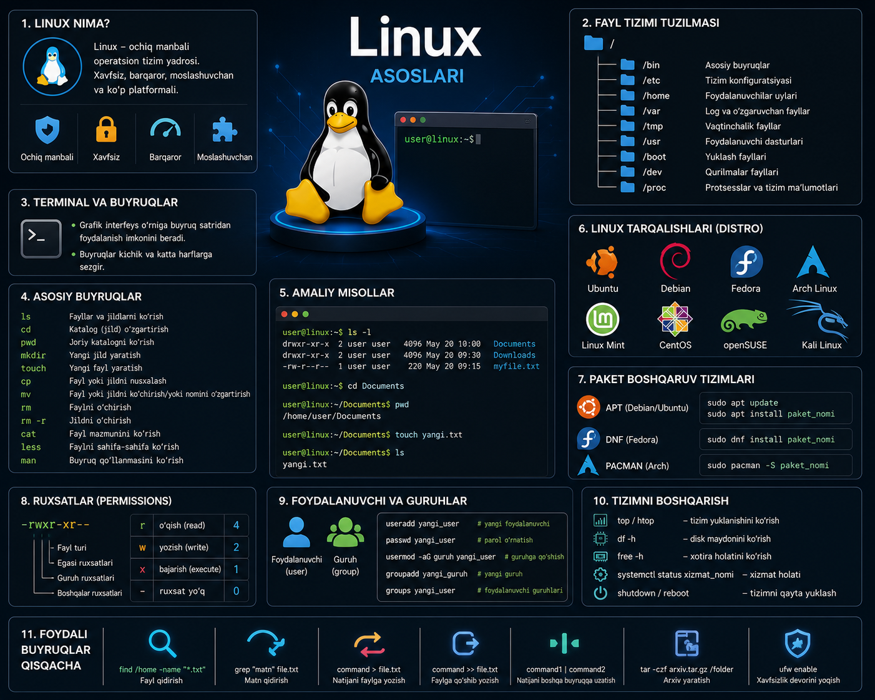
Linux is an open-source operating system built around the Linux Kernel, originally created by Finnish software engineer Linus Torvalds in 1991.
Linux offers numerous advantages, including:
open-source development;
free distribution;
high security;
excellent stability;
multitasking capabilities;
multi-user support;
flexibility and customization;
outstanding performance.
Because of these characteristics, Linux is widely used in personal computers, enterprise servers, cloud infrastructure, and embedded systems.
Linux forms the backbone of modern digital infrastructure.
It is commonly used in:
web servers;
cloud computing platforms;
supercomputers;
Android devices;
Internet of Things (IoT);
artificial intelligence systems;
DevOps environments;
cybersecurity laboratories;
scientific research.
Many of the world's largest technology companies rely heavily on Linux-based systems.
Although all Linux distributions share the same kernel, they differ in software packages, user experience, and intended use.
Popular Linux distributions include:
Ubuntu;
Debian;
Fedora;
Rocky Linux;
AlmaLinux;
Red Hat Enterprise Linux (RHEL);
CentOS Stream;
Arch Linux;
Kali Linux;
Linux Mint.
Each distribution is designed to meet different user needs, from beginners to enterprise professionals.
Linux organizes files using a hierarchical directory structure.
Important directories include:
/ — Root directory;
/home — User home directories;
/etc — System configuration files;
/var — Variable data and log files;
/usr — User applications and libraries;
/bin — Essential system commands;
/tmp — Temporary files;
/opt — Optional software packages.
Understanding the Linux file system is essential for efficient system administration.
One of Linux's greatest strengths is its powerful command-line interface.
The terminal allows users to:
manage files;
install software;
administer servers;
automate repetitive tasks;
monitor system performance;
write shell scripts;
troubleshoot technical problems.
Although graphical interfaces are available, experienced Linux professionals rely heavily on the terminal for daily tasks.
Every Linux user should become familiar with common command-line tools.
Frequently used commands include:
pwd
ls
cd
mkdir
rm
cp
mv
cat
nano
vim
touch
find
grep
chmod
chown
ps
top
kill
sudo
apt
dnf
Mastering these commands greatly improves productivity and system management skills.
Linux uses a robust security model based on users and permissions.
Important concepts include:
User;
Group;
Root;
Ownership;
Permissions.
Each file can have three types of permissions:
Read (r);
Write (w);
Execute (x).
Permissions are assigned separately to:
Owner;
Group;
Others.
This permission model is one of the primary reasons Linux is considered highly secure.
Software installation in Linux is managed through package managers.
Popular package managers include:
APT (Ubuntu, Debian);
DNF (Fedora);
YUM;
Pacman (Arch Linux);
Zypper (openSUSE).
Package managers simplify installing, updating, and removing software while maintaining system consistency.
A structured learning path helps beginners gain confidence.
Recommended steps include:
Install a Linux distribution.
Learn basic terminal commands.
Understand the Linux file system.
Practice file and directory management.
Learn Bash scripting.
Explore server administration.
Study Git and Docker.
Build personal Linux projects.
Experiment using virtual machines or Windows Subsystem for Linux (WSL).
Consistent hands-on practice is the most effective way to master Linux.
Linux continues to play a critical role in modern computing.
Key areas of future growth include:
Cloud Computing;
DevOps;
Kubernetes;
Docker;
Artificial Intelligence;
Big Data;
Cybersecurity;
Edge Computing;
Internet of Things (IoT);
High-Performance Computing (HPC).
As organizations continue adopting cloud-native technologies and open-source software, Linux expertise will remain highly valuable.
Linux is one of the most important operating systems in today's technology landscape. Its stability, security, flexibility, and open-source philosophy have made it the preferred platform for servers, cloud infrastructure, software development, cybersecurity, artificial intelligence, and scientific computing. Learning Linux provides a strong technical foundation for anyone pursuing a career in Information Technology. For students and educators of the Bukhara State Pedagogical Institute, mastering Linux fundamentals opens the door to advanced technologies, professional certifications, global career opportunities, and lifelong success in the digital economy.
SEO Keywords: Linux fundamentals, Linux operating system, Linux tutorial, Linux basics, Linux commands, Linux terminal, Ubuntu, Debian, Bash, Shell scripting, Linux server, DevOps, Cybersecurity, Open Source, Cloud Computing, Bukhara State Pedagogical Institute.