(365) 226-10-97 buxdpi@buxdpi.uz 2 Piridastgir Street, Bukhara City
shape
shape

No-Code Platforms: Building Modern Applications Without Programming

No-Code Platforms: Building Modern Applications Without Programming

No-Code Platforms: Building Modern Applications Without Programming

No-Code Platforms: Building Modern Applications Without Programming

The rapid pace of digital transformation has significantly increased the demand for software applications across every industry. Businesses, educational institutions, government organizations, and startups are constantly seeking faster and more affordable ways to develop digital solutions. Traditionally, software development required skilled programmers, extensive coding knowledge, and substantial financial investment. Today, No-Code platforms are changing this landscape by enabling users to build applications without writing a single line of code.

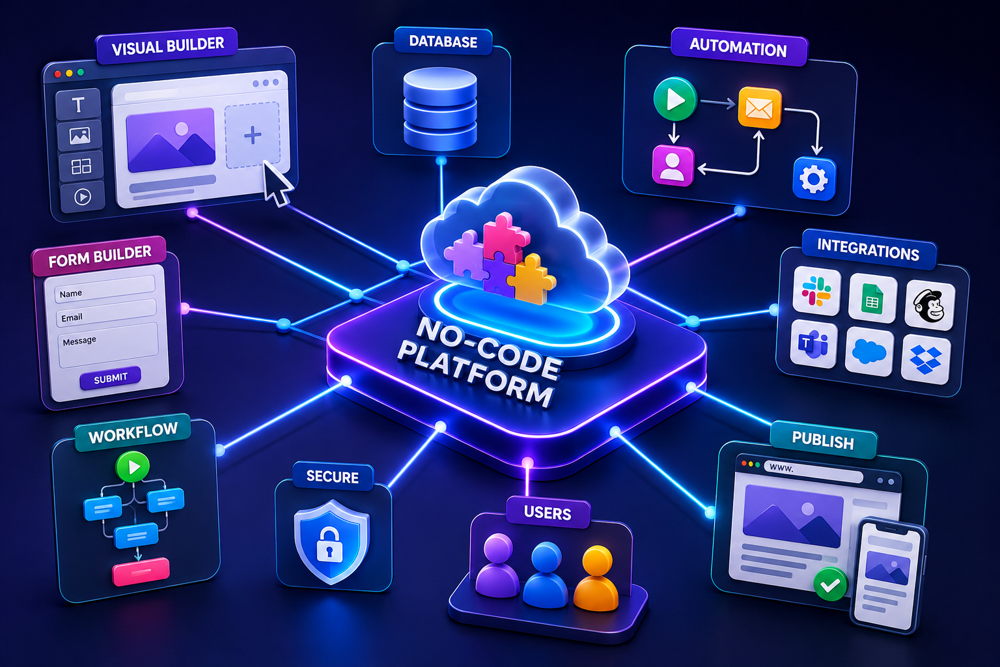
No-Code platforms provide visual development environments where users can create websites, mobile applications, databases, workflow automation systems, and business management tools using drag-and-drop interfaces. These platforms empower entrepreneurs, educators, business professionals, and students to transform their ideas into functional digital products quickly and efficiently.

For students and educators at the Bukhara State Pedagogical Institute, learning No-Code platforms offers an excellent opportunity to develop practical digital skills, create innovative solutions, automate business processes, and launch entrepreneurial projects without extensive programming experience.


1. What Are No-Code Platforms?

No-Code platforms are software development tools that allow users to build applications through visual interfaces instead of writing traditional programming code.

Using No-Code platforms, users can create:

  • websites;

  • mobile applications;

  • customer relationship management (CRM) systems;

  • business management tools;

  • online stores;

  • databases;

  • chatbots;

  • workflow automation systems.

The entire development process is performed using graphical components and pre-built templates.


2. Why Are No-Code Platforms Important?

Software development has traditionally required experienced developers, long development cycles, and significant financial resources.

No-Code platforms solve these challenges by offering:

  • faster application development;

  • lower development costs;

  • reduced technical barriers;

  • rapid prototyping;

  • easier collaboration;

  • simplified maintenance;

  • quicker deployment;

  • greater accessibility for non-technical users.

These advantages enable organizations to innovate more rapidly and respond quickly to changing business needs.


3. No-Code vs. Low-Code

Although the terms are often used together, they have important differences.

No-Code

  • requires no programming knowledge;

  • uses fully visual development tools;

  • designed for business users and beginners;

  • ideal for simple and medium-complexity applications.

Low-Code

  • requires limited programming;

  • allows custom code when needed;

  • supports more complex enterprise applications;

  • suitable for professional developers as well.

Organizations choose between these approaches depending on project complexity and technical requirements.


4. How Do No-Code Platforms Work?

Most No-Code platforms provide a collection of visual development tools.

Typical features include:

  • drag-and-drop builders;

  • ready-made templates;

  • visual UI components;

  • database management tools;

  • workflow automation;

  • API integrations;

  • user authentication;

  • cloud hosting.

Instead of writing code, users configure components and define application logic through graphical interfaces.


5. Popular No-Code Platforms

Many powerful No-Code solutions are available today.

Some of the most popular platforms include:

  • Bubble;

  • Webflow;

  • Glide;

  • Adalo;

  • Airtable;

  • Softr;

  • Zapier;

  • Make;

  • Notion;

  • Carrd.

Each platform specializes in different types of applications and business requirements.


6. Advantages of No-Code Platforms

No-Code development offers numerous benefits.

Major advantages include:

  • rapid development;

  • cost efficiency;

  • user-friendly interfaces;

  • visual application design;

  • built-in automation;

  • seamless integrations;

  • faster testing;

  • easier maintenance;

  • shorter time-to-market.

These benefits help organizations launch products more quickly while reducing development risks.


7. Applications of No-Code Platforms

No-Code solutions are widely used across various industries.

Common application areas include:

  • education;

  • healthcare;

  • e-commerce;

  • customer relationship management (CRM);

  • human resource management;

  • marketing;

  • logistics;

  • government services;

  • startups;

  • project management.

Organizations increasingly rely on No-Code tools to improve operational efficiency and accelerate digital transformation.


8. API Integration in No-Code Platforms

Modern No-Code platforms can connect with numerous external services through APIs.

Common integrations include:

  • Google Sheets;

  • Gmail;

  • Telegram;

  • Slack;

  • Stripe;

  • PayPal;

  • cloud storage services;

  • CRM systems;

  • ERP software;

  • artificial intelligence services.

API connectivity significantly extends the functionality of No-Code applications.


9. How to Learn No-Code Development

A structured learning path helps beginners become productive quickly.

Recommended steps include:

  1. Learn the fundamentals of No-Code development.

  2. Build a simple website.

  3. Explore database management.

  4. Learn API integrations.

  5. Study workflow automation.

  6. Develop a mobile application.

  7. Complete real-world projects.

  8. Build a professional portfolio.

Practical experience is the most effective way to master No-Code development.


10. The Future of No-Code Platforms

The future of No-Code development is closely connected with artificial intelligence and cloud computing.

Emerging trends include:

  • AI-assisted application development;

  • intelligent workflow automation;

  • cloud-native No-Code platforms;

  • AI chatbot integration;

  • Internet of Things (IoT) connectivity;

  • enterprise-grade No-Code solutions;

  • hybrid Low-Code/No-Code platforms;

  • automated business process modeling.

As organizations continue their digital transformation, No-Code technologies are expected to become an increasingly important part of software development.


Conclusion

No-Code platforms have transformed the software development landscape by making application creation accessible to people without programming experience. Through visual interfaces, ready-made components, and powerful integrations, these platforms enable individuals and organizations to build websites, mobile applications, business systems, and automation workflows quickly and efficiently. For students and educators at the Bukhara State Pedagogical Institute, mastering No-Code platforms provides valuable opportunities to develop digital products, support entrepreneurship, automate organizational processes, and prepare for careers in today's rapidly evolving technology industry.

SEO Keywords: No-Code platforms, No-Code development, Low-Code, Bubble, Webflow, Glide, Airtable, Zapier, Make, API integration, workflow automation, mobile app development, digital transformation, cloud computing, Bukhara State Pedagogical Institute.